
One of the most common topics discussed in the brain injury support groups and by my coaching clients is about working after traumatic brain injury. People want to know when they will be able to go back. How long will their family have to make due without their income? When will things get back to “normal”?
It is very difficult to give an answer to this question. There are so many variables. Some of them you have control over like the doctors you work with and the mindset you take to recovery. Other variables you have little control over, such as how you go through the grieving process and the physiological progress your brain makes.
My own journey back to work included both of these types of variables.
Working After My Injury
In one sense my journey back to work was a short one. I was back at the office about 10 days after my injury that put me in the hospital for a week. However, my journey back to competence, productivity, and excellence was a much longer one.
The only restrictions I had when I left the hospital were related to some broken bones I had. The doctors did not give me any restrictions related to the TBI. I was driving the day after I left the hospital. I was back to work the following week. In my blissful naivete, I expected to be 100% and firing on all cylinders.
It quickly became apparent that that I wasn’t.
I’ve written elsewhere that I was really on fire with a new company. Shortly before the injury our company’s owner gave me a substantial, unasked for raise. He said I was going the extra mile, anticipating problems, and taking weight off his shoulders.
Post injury, I felt like a lead weight around his neck. My short term memory was zero. The owner would give me instructions for something urgent, then ask for an update 15-20 minutes later. Not only did I not remember what he had asked for, I didn’t even remember him asking me. It was really bad! On one occasion, I almost cost the company $20,000, because I forgot something the owner told me.
These short term memory problems were bad enough by themselves. It turned out that I was also experiencing some very different feelings than I had ever faced before my injury, specifically anger. Small, insignificant things would set me off.
Fortunately, I never exploded on my boss. For that matter, I never exploded on anyone. I kept it all inside. I would start off each day A OK, but by 12 or 1pm, I was seething inside. So much of my mental and cognitive energy was being used to hold myself together.
I was working for a commercial construction company as a project manager. The construction industry is fairly confrontational. A good memory and cooler heads usually come out ahead. I had no memory, and the confrontation (or the smallest perception of confrontation) would trigger me everyday.
Obviously, the owner kept putting pressure on me to improve my performance and get my act together. That would direct my ire towards him, and make it harder to get out of my own way.
Being My Own Obstacle
I was mad at everyone. And I do mean everyone: my boss, coworkers, family, and friends. The anger was real and directed at those closest to me.
It was a while later until I realized that I was also &%$@! scared. I felt like so much was out of my control. My brain wasn’t working, and I didn’t now how to fix it.

My doctors’ only advice was “time and patience.” Easy for them to let those words roll flippantly off their tongue.
They weren’t the ones with the broken brain.
They weren’t the ones afraid they would have to end their career.
They weren’t the ones afraid they would have to move back with their parents.
They weren’t the ones afraid they would lose the mental strength to keep fighting and moving forward.
They weren’t the ones afraid they would become a burden on their parents.
They weren’t the ones afraid they wouldn’t be able to get married, support a family, and enjoy being a dad.
Those freaking doctors! I’m getting worked up writing this. I’d better move on.
The mood changes and anger were being combined with pure fear of what would become of me if my brain didn’t fix itself. And all the doctors. Trained doctors. A neurologist and a brain surgeon. Could tell me was “time and patience.” Uh, I’m getting worked up again. Sorry about that. Let’s keep going.
All that fear and anger kept seizing up and exhausting my brain. Everything I had was being used to hold it together. I’d like to say I had some huge realization and let the anger and fear go, but I didn’t. I think it stuck around in some form or another until 18 months or so after my injury.
All that baggage made working that much harder. I really wish I’d have had someone to help me start working through it earlier.
Working, The Best Therapy
I truly think that part of the reason I recovered so well and got back so much of my cognitive function was because I kept working. Even when it was brutally hard, and when I wanted to throw in the towel. That’s a bold statement, and I mean it.
But before I go any farther, I am not in any way criticizing anyone who cannot work. Every injury is different. Every situation is different. This is what worked for me. If you cannot work, I still think you can take something away from what I’m about to share. My next post is just for you guys. And I’ve got a resource for you that might give you a way to earn some income.

Given the lack of information my medical team gave me, I didn’t have any cognitive therapy to help me work out my deficits. So working became my therapy. I became my therapist.
These are the steps I typically used for problems at work.
- Step 1: See a problem
- Step 2: Look for the cause
- Step 3: Find a solution
- Step 4: Test it
- Step 5: Repeat
I approached my traumatic brain injury deficits just like I did my work problems. Steps 1 and 2 were fairly obvious:
- Step 1: See a problem
- Poor short term memory
- Lots of anger
- Poor logical thinking (thinking more than 1 or 2 steps through a work problem)
- Poor cause and effect thinking (analyzing the consequences of a course of action)
- Step 2: Look for the cause
- Obviously, my broken brain
Here are are the approaches I took to find and test solutions, and then repeat the process to keep making forward progress in the four areas I mentioned above.
Solution to Problem 1: Memory
Part 1
While my memory pre-injury was not stellar, it seemed to be good enough to get the job done. I wasn’t sure what to do about the diminished memory that I had post injury.
A few months after my injury, I was listening to a podcast. The guest on the podcast was promoting his book and talking about the efficiency of his todo list strategy.
Prior to this, I didn’t know that todo list strategies existed. Pre-injury I would occasionally use a notepad. Post injury, I was struggling to implement something to keep me on track and compensate for my broken brain.
I bought the book and read it in two weeks. I decided to implement it. It was going to take some time to set everything up. But once the setup was complete, this system was supposed to take everything out of my head. I would have a physical or digital way to file everything and retrieve it.
It took a weekend to do the setup. I spent part of the day at the office, and part of the day at home doing the physical setup. In the evening I did the digital setup. Having it digital was extremely important, because I traveled a lot to different job sites. Paper wasn’t always available.
The strategy was a HUGE success. I started capturing what people told me and getting it into a system to process.
Part 2
It wasn’t foolproof, though. The next problem was remembering to use my shiny new system. Recording things was easy enough. But remembering to look at my list wasn’t. I set reminders on my phone to look at my list every half hour.
Eventually, the habit of reviewing my list became ingrained, and I could eliminate all of the reminders.
In the nearly 7 years since my accident, I have adapted the todo strategy I read in the book to suit my personal needs. Early on, I needed more structure to be effective. As my memory improved, I was able to relax the structure.
I’ve switched the digital program I use 3 times as I’ve learned what works best for me. I’m going on 3 years with my current program.
Solution to Problem 2: Lots of Anger
Part 1
This is the solution I started figuring out first. I knew it almost immediately. At least I thought I did. I’ve often used exercise as a way to manage stress. But this option wasn’t immediately available to me. In the first two months following my injury, I was on restricted activity due to my broken bones.
For that period of time, I had no way to manage my feelings. It was all piling up.
The day the doctors cleared me for activity, I ran 2 miles. It felt so good! I was so happy to be rid of the pent up emotions. I could finally control things.
Not so fast there, tiger.

Pre-injury, a good run was enough to send me into a great night sleep and wake up refreshed. Post-injury, my runners high, as it is sometimes called, only lasted for 20 minutes. Turns out that something in my new brain didn’t get the same mental and emotional results from exercise.
Exercise was useful for about 60 minutes of relief (30 minutes exercise, 30 minutes runners high), but it wasn’t the solution to lengthly stress management. I was heartbroken. My 10 week hope for relief was not to happen. I felt destined for a life of these pent up emotions, and further distance myself from people close me.
Part 2
Finally, 8 months post injury, I found a doctor who specialized in TBI that suggested trying medication. It wasn’t an antidepressant. He called it a mood stabilizer. I was nervous about it. But he said it was a low dose, and what did I have to lose?
It took a few weeks to get the dose right, but HOLY COW! What a difference! All of those emotions amplified by the brain injury were finally reined in.
Work was great for giving me lots of opportunities to test my emotional limits. Problems would come up, confrontations would happen, and I wouldn’t internalize the anger and frustration. I was finally able to stay even keel.
While my emotions are not as wily as they used to be, I find that the medication still helps me stay even keel. My poor wife says I’m really cranky when I don’t take it.
Solution to Problem 3: Poor Logical Thinking And Poor Cause And Effect Thinking
Part 1
There were lots of steps on the stairway to working out this solution.
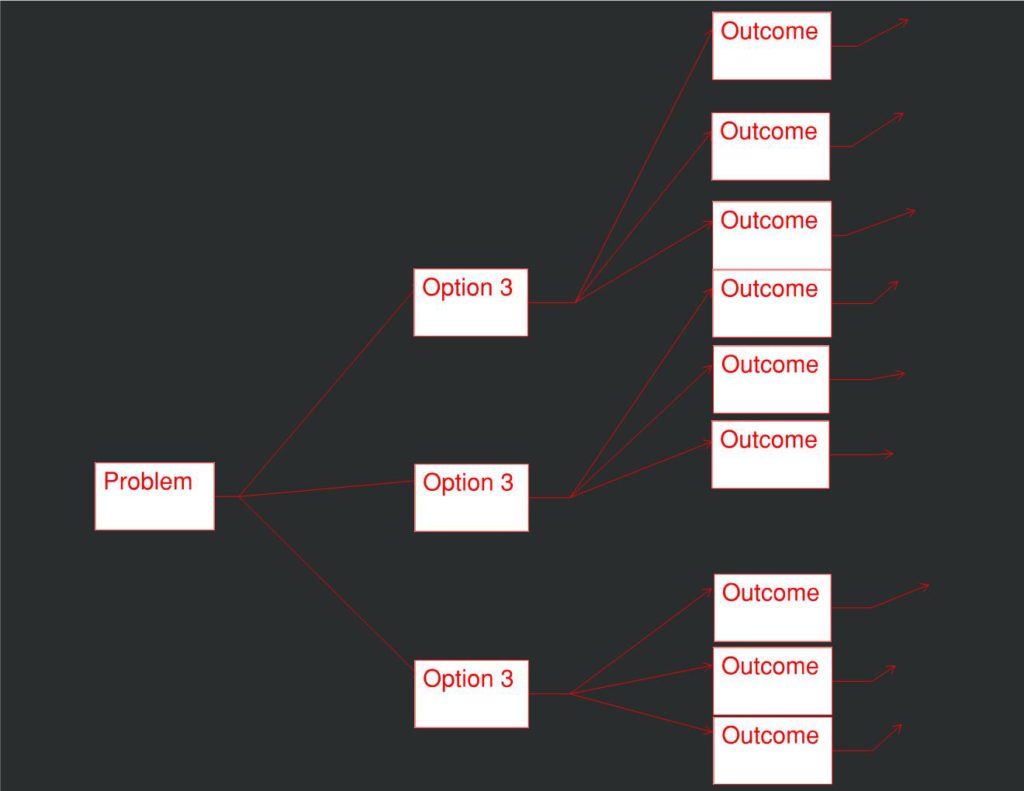
In the early days (0-8 months post injury), I would have to draw out all of my decisions and problems at work.
It helped me think through things and visualize them. I continued to do this with reducing frequency until about 1 year post injury.
Part 2
The mood stabilizer that reined in my emotions had an unexpected side effect. Since I wasn’t using so many of my mental resources to hold my emotional self together, those resources could now be used to repair functions like thinking and reasoning.
Part 3
The last step was a neuro-psych test. This test was recommended by the same doctor who gave me the mood stabilizer.
The test is meant to examine your different cognitive functions and highlight the strengths and weaknesses.
It’s a grueling 4 hour ordeal. It’s supposed to be. It’s supposed to exhaust your brain, so the weaknesses show through.
It took the psychiatrist 2 weeks to analyze the results. Since she had no baseline for my pre-injury function, she had to look for unusual results.
They weren’t hard to find. I performed in high percentiles in several areas, while there were others that were in the remedial range.
It was extremely useful to know exactly where my weaknesses were. She also took some time with me to come up with strategies to play to my strengths while my weaknesses recovered.
Back at work, I was able to review the results and strategies with my boss. He even helped me come up with some other strategies that were extremely helpful.
Lessons
There are a few things I want to highlight from my experience with this.
- It was STINKING HARD! My brain was trying to fix itself, I was trying to earn my paycheck, AND I was trying to figure out how my brain was working. I slept so much in the early months of my recovery.
-
My first solution to the problems mentioned above was never my permanent solution. The first solution was an improvement over where I started out. It lightened my mental and emotional load just enough to learn. I took what I learned and improved it. Figuring things out what a process. I’m really glad that I took the first step to move me in the right direction.
It’s not important to have the perfect idea. But it is important to have an idea and be willing to try moving forward. If it’s not what you hoped and doesn’t work out, we need to go back to the drawing board and try something else.
- I had to be brutally honest with myself. I would not have changed anything if I didn’t think anything was wrong. I could have lived in denial of the effects of my traumatic brain injury. I could have blamed everyone for making me angry or not telling me something. Nothing would have improved if I didn’t take responsibility for improving it. I had to own where I was at and decide that I was going to figure it out.
- Making sure I got enough rest was very important. I would feel so drained after work that I would go to sleep without dinner. If fatigue is something you face, be kind to yourself and allow your brain and body the time it needs to rest.
- It’s not always prudent to tell your employer the extent of your deficits. I know I mentioned earlier that my boss put pressure on me to improve performance. But overall my employer was very supportive in the process of my recovery. The simple fact was that he didn’t know what else to do, and neither did I. The results of the neuro-psych test gave me something concrete to talk to him about, and ideas to help improve things. There are pros and cons to talking to your employer. How many of each depends on your position, your relationship, etc. Use wisdom when deciding how much to share.
Conclusion
I learned so much from sticking with it and relearning how to work. I gained grit, a respect and appreciation for those with challenges much greater than mine, and a solemnity for how fragile our minds, emotions and personalities can be.
If you want to return to work, or find some way to find meaning or contribute, I hope you won’t give up. Work the steps.
- Step 1: See a problem
- Step 2: Look for the cause
- Step 3: Find a solution
- Step 4: Test it
- Step 5: Repeat
It might not be easy. The first idea you come up with might not be the best, but at least you’re trying. And that’s all any of us can do.
Did you return to work after you’re TBI? Did you return to work and leave? Did you find some way to stay busy, engaged, and moving forward, even when you couldn’t work a traditional job?
I’d love to hear about it in the comments below.

https://shorturl.fm/6gfiu